
Crypto for Advisors: Why Timing the Bitcoin Cycle Beats Dollar-Cost Averaging
In this edition, Markus Thielen of 10x Research makes the case that a cycle-aware allocation framework consistently outperforms traditional dollar-cost averaging when applied to Bitcoin. Following that, our “Ask an Expert” segment features Eric Tomaszewski of Verde Capital Management, who explains why advisors need to dig beneath headline metrics to locate where genuine value is accumulating.
Also this week: TrackInsight is running a brief survey on how financial advisors are integrating crypto ETFs into client portfolios. The two-minute survey offers participants early access to the findings.
Why Bitcoin Punishes the DCA Playbook That Works Everywhere Else
The strategy that quietly builds wealth in equity markets can actively destroy it in Bitcoin. Recognizing why requires understanding how fundamentally different this asset’s behavior really is.
Dollar-cost averaging earns its reputation in traditional finance for good reason. Spreading purchases over time smooths volatility, removes the temptation to time entries, and works well for assets like stocks and bonds that trend upward over the long haul. For most retail investors holding conventional portfolios, it’s close to the ideal approach.
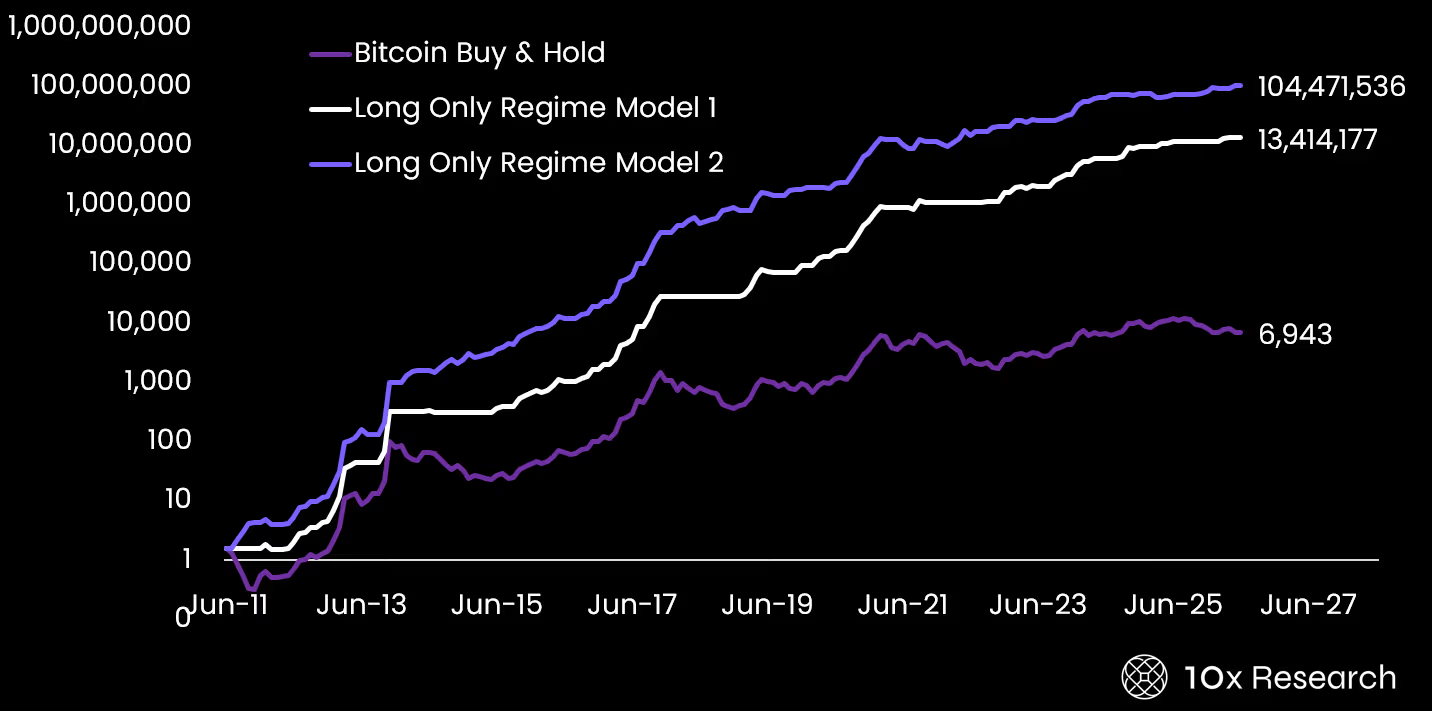
Bitcoin, however, doesn’t play by those same rules — and applying DCA to it without adjustment is one of the costliest errors advisors make on behalf of clients. Since 2011, Bitcoin has moved through four complete market cycles, each following a remarkably consistent script: a halving event tightens new coin supply, adoption-driven demand accelerates, prices climb sharply, leverage accumulates throughout the system, and the cycle eventually reverses into a drawdown that has historically exceeded 70%.
Across Bitcoin’s full trading history, a buy-and-hold investor would have experienced a peak-to-trough drawdown of -80%. That’s not some rare tail-risk event — it has happened three separate times. The familiar pattern plays out again and again: capitulation near the bottom, followed by missing much of the eventual recovery. Viewed on a long-term chart, the overall return still looks remarkable, masking just how brutal the path to get there actually was.
DCA only softens that path marginally. Investors who steadily accumulated Bitcoin throughout the 2021-2022 cycle still suffered devastating mark-to-market losses once the bear phase took hold. The strategy provides emotional reassurance more than it provides mathematical protection, since it doesn’t reduce market exposure when conditions have structurally deteriorated.
Regime Detection as the Smarter Alternative
A more effective approach centers on identifying market regimes rather than averaging blindly through them. Bitcoin tends to spend extended stretches — generally 12 to 18 months — firmly in either a bullish or bearish regime, either compounding gains at an exceptional pace or erasing most of what was previously built. Critically, these regime shifts aren’t random; they can be anticipated using observable price action and on-chain network data.
Thielen’s research tracks ten independent indicators spanning momentum, trend, and on-chain cost-basis metrics to triangulate the prevailing regime. The results are striking: when most of these signals point positive, Bitcoin’s average monthly return runs around +25%. When the majority turn negative, that average flips to roughly -6% — a spread of 31 percentage points that underscores just how much regime context matters.
Backtesting a cycle-aware, long-only strategy against simple buy-and-hold over a 15-year span produced a Sharpe ratio of 1.22 versus 0.82, while slashing the maximum drawdown from -80% down to -44%. For advisors operating under a fiduciary mandate or formal investment policy statement, that kind of improvement can be the difference between a strategy that clears a risk committee and one that doesn’t.
Building a Dynamic Allocation Framework
None of this means Bitcoin should be excluded from diversified portfolios — the long-term return premium and diversification benefits remain real and measurable. But the allocation approach should reflect Bitcoin’s true nature as a cyclical asset, shaped by its four-year supply schedule, waves of institutional adoption, and leverage dynamics that magnify both rallies and crashes.
In practice, this might mean replacing a fixed Bitcoin position with a dynamic allocation band. A mandate could cap Bitcoin exposure at 5%, for example, while leaving the actual deployment — fully invested, half-invested, or sitting at zero — contingent on where the cycle currently stands. Rules-based regime signals, whether built in-house or sourced from research providers, offer a systematic framework for those decisions without requiring discretionary market calls.
It’s worth noting that a cycle-aware strategy doesn’t necessarily win by being right more often than buy-and-hold. Instead, it wins by sidestepping the specific months when Bitcoin loses 20%, 30%, or even 40% of its value. Those punishing months tend to cluster together, and stepping aside during them isn’t really market timing — it’s reading the cyclical structure embedded in the asset itself.
Thielen points to three public, timestamped calls his firm has made since 2022 as evidence of the framework’s track record: identifying the October 2022 cycle bottom, projecting a $125,000 target in July 2023, and flagging a bear signal in October 2025 — each rooted in the same underlying methodology. He’s careful to note the approach isn’t infallible, but argues it’s systematic, auditable, and far better suited to Bitcoin’s cyclical behavior than the passive strategies most advisors currently rely on.
The broader takeaway: Bitcoin rewards investors who understand its cyclical nature. Advisors treating it like any other asset class risk leaving substantial risk-adjusted returns on the table — and exposing clients to drawdowns severe enough to end portfolios rather than simply test their patience.
Ask an Expert: Is Crypto Measuring the Wrong Things?
If blockchain succeeds, are investors actually holding the right assets?
For years, the prevailing assumption was straightforward: growth in a blockchain ecosystem would naturally translate into appreciation for its native token. That assumption is looking increasingly shaky. Technology can become essential to an ecosystem while the economic value it generates flows elsewhere entirely — to sequencers, applications, stablecoin issuers, or liquidity layers. For fiduciaries, the real opportunity may lie not in identifying which technology gets adopted, but in understanding where the economics ultimately settle, and whether existing valuation frameworks for crypto assets need to evolve alongside it.
Is the market underestimating Ethereum’s true role?
Much of the current debate fixates on whether Layer 2 networks are siphoning fees and users away from Ethereum’s base layer. But reserve assets have never derived their value primarily from transaction frequency — they derive it from being held, trusted, and used as collateral. Should ETH evolve into productive collateral for institutions, decentralized organizations, and eventually autonomous AI agents, the current debate over gas fees may look, in hindsight, like a distraction from the emergence of a genuine digital reserve asset. After all, the world’s major reserve currencies weren’t built on spending volume — they were built on savings and trust.
Could the biggest opportunity be the intersection of AI and crypto, rather than either alone?
Historically, major technological revolutions have emerged from pairing: the Industrial Revolution combined machines with energy, and the internet combined humans with information. The next major shift may pair autonomous AI agents with programmable finance. If artificial intelligence becomes capable of independent economic activity, and blockchain supplies the trust and settlement infrastructure underneath it, investors may need to fundamentally rethink what qualifies as core infrastructure. The timing and scale of that convergence remain uncertain, but history suggests transformative opportunities often emerge precisely where major technology shifts overlap.
Are investors still measuring the wrong metric entirely?
The industry has long celebrated Total Value Locked (TVL) as a headline indicator of protocol success, yet TVL frequently reflects how much capital is parked in a protocol rather than how much economic value actually flows back to its owners. Platforms like Hyperliquid have begun challenging that convention by prioritizing revenue distribution and direct alignment with token holders, while Aerodrome’s shift toward predictive, continuous capital allocation suggests that capital itself is becoming increasingly programmable and dynamically optimized. As the crypto market matures, the most compelling opportunities may not come from identifying protocols with the highest activity levels, but from those most effective at capturing, allocating, and returning real economic value to the people who actually own them.
External Links:










Leave a Reply